Central Florida: Two Engines and a Lighter Gate
In Central Florida the forces are growth and tourism, and for the first time the approval gate gets lighter.
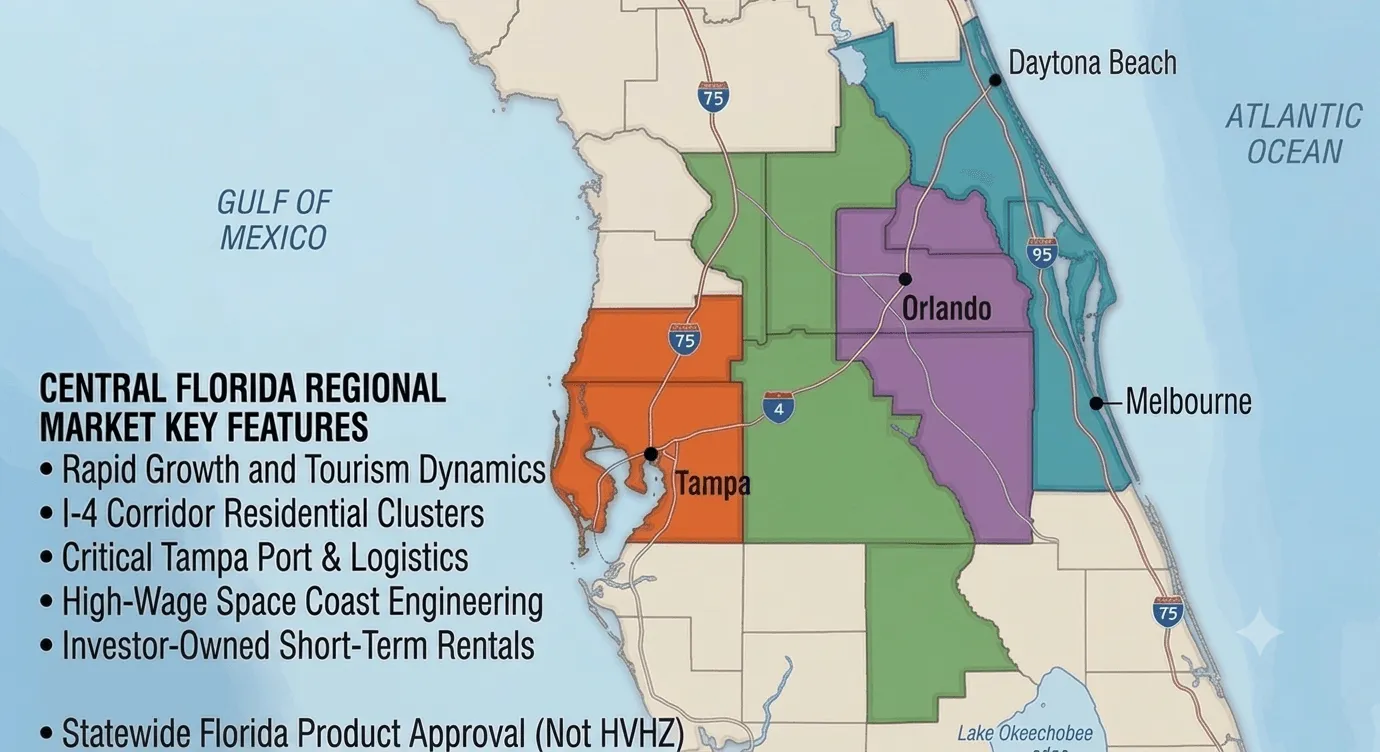
In the center of the Florida peninsula the conditions change enough once again to force anyone trying to do business there to redesign, or at least heavily adapt, their commercial strategy.
If stringent codes with a strong Hispanic influence marked the Southeast Florida sub-region, and Midwestern snowbirds in gated HOA-governed communities marked the Southwest, here in Central Florida the organizing forces are growth and tourism.
Two engines are pulling people and construction at a pace rarely seen anywhere in the country. The first runs along the I-4 corridor, the spine that links Tampa on the gulf to Orlando in the center of the state, with aggressive residential development filling in the whole length of it. Tampa’s port access has helped ignite the fastest-growing warehouses and distribution clusters in Florida, built to serve e-commerce and retail across the region and second only to Atlanta in the Southeast.
The second engine sits on the Atlantic coast, around Palm Bay, Melbourne, and Viera. Aerospace and defense work draws in thousands of engineers and technicians, anchored by L3Harris, headquartered in Melbourne and the largest private employer on the Space Coast, alongside SpaceX, Blue Origin, Lockheed Martin, and NASA at Kennedy Space Center. The pay runs well above the regional median, commonly $100,000 to $140,000 for mid-career engineers and $200k+ for specialized roles. Florida’s lack of a state income tax stretches every dollar further. New houses, apartments, and the commercial development that follows them are going up across the area.
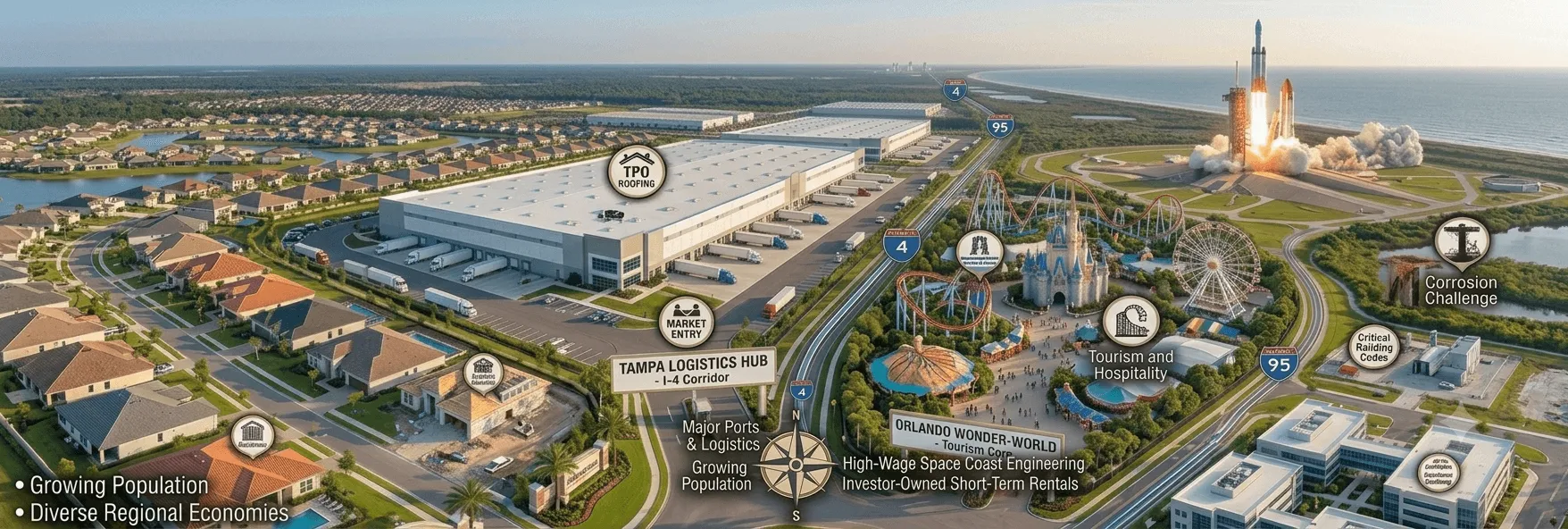
At the Orlando end of that corridor sits the tourism core. Orlando drew roughly 75 million visitors in 2024, a record, most of them domestic and most staying under a week. That visitor economy has built a deep stock of investor-owned, short-term rental housing around Osceola, Polk, and the Davenport-Kissimmee-Champions Gate belt, where the person who owns the roof is rarely the person who sleeps under it.
One thing ties the whole region together and separates it cleanly from the Southeast. None of Central Florida sits inside the High Velocity Hurricane Zone, so the statewide Florida Product Approval governs here, not the Miami-Dade NOA. For a manufacturer that is a real and welcome difference, a lighter gate than the one guarding the southeast coast. The relief is not total though. The Atlantic side still carries salt air and wind-driven rain that punishes the wrong coating or fastener, even without the HVHZ tier.
A building materials company competing in Central Florida therefore weighs flood and surge on the gulf side, wind and salt on the Atlantic side, and an investor-driven rental logic in the tourism core. The dynamics of each sub-zone are different, and so are their priorities, their price sensitivity, and the design lifecycle each local customer will pay for. Warehouse and e-commerce space, tourism and hospitality, and healthcare are driving commercial roofing, where TPO is the king. Energy compliance, material innovation, and rising insurance costs are the forces that need to be understood to navigate these waters.
In the next article we continue northbound, into Northeast Florida.
I write when something worth saying happens in global trade. If that’s a conversation you want to be part of, leave your email.